
You found your salmon fishing hole by scoping out new territory last season. But the season is over, and you've stowed your gear. So, should you return to your newly discovered salmon hotspot next season? To answer this question, research on salmon migration helps. Salmon journey thousands of miles from the middle of the ocean to return to the place of their beginnings with remarkable specificity.
 Salmon Return To Birthplace Stream
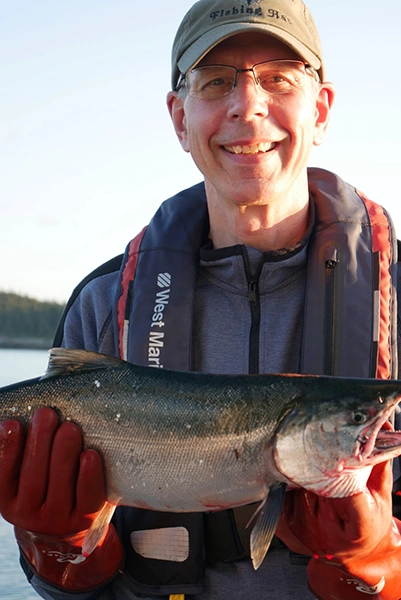 Salmon Return To Birthplace Stream
However, what may not be known is most salmon carve out a nest in the same stream, gravel bed, or river bottom as their parents and grandparents did. Scientists call this behavior homing, and salmon are good at it. Getting a little nerdy here, but even more fascinating is the idea of olfactory imprinting. The concept is that the little salmon (smolt) can detect the specific smell of their natal stream and these birthplace stream odors become permanent memories. This process happens when smolt swim from freshwater to its ocean growth area.
When salmon mature and become spawning age, the return journey to its birthplace stream begins. Adult salmon home to a precise stream bottom by remembering and following distinct natal stream smells. So skilled are salmon at detecting the native stream odors that they can pick out the correct river to swim up even when it branches into smaller and smaller tributaries.
Salmon Follow Same Water Trails
So what does this have to do with your salmon fishing hole in the salt? Salmon's olfactory-based homing behavior might be most active in freshwater. Scientists are unsure what specific biological mechanism drives homing behavior in saltwater. More research is needed to pinpoint how salmon navigate in their saltwater environment.
Still, ideas include visual navigation, magnetic or compass guidance, light cues, and other biological or chemical guides. But, to answer our question about revisiting a newly found salmon fishing hole, anglers don't need to know precisely how salmon navigate in saltwater. Instead, we need to know that they are heading back to a specific point in a stream or river, and they follow ancient water trails to get there.
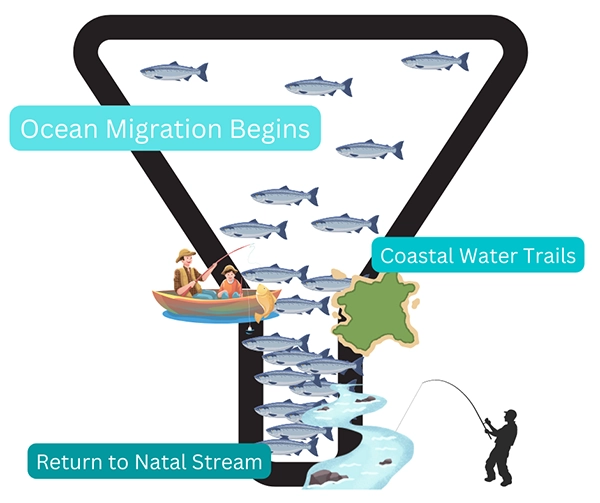 Visualizing the process like a funnel might help. The ocean is the top of the funnel, coastal water is the necked-down part, and the end funnel point is the stream bed. As salmon get closer to their targeted stream bed, the funneling process pushes more and more salmon into a smaller space.
Yes, Keep Your Salmon Fishing Hole
As last month's blog showed, scouting homework leads to a new salmon saltwater hotspot. Since we know salmon can find the same stream bed after migrating thousands of miles using stream smells. It is easy to believe that no matter the saltwater homing navigation mechanism, they will pass through your fishing hole again. So, yes! Keep your new saltwater salmon fishing hole on your list. New generations of returning, food-seeking salmon will come by again. Get your gear ready this winter. Before you know it, next year's salmon season will be here. And don't forget to add Scent Striker and DBS to fill your fish box.
Happy Fishing! Don Habeger Founder