
Why salmon follow but don’t commit
You’ve probably seen it. You’re fishing water that should hold salmon. Your gear is solid. You’ve cycled through colors. You’re working different depths.
Then a fish shows up — you feel it on the rod tip or spot it on the sonar. It tracks your bait… and keeps tracking. But it never finishes. When that happens, it’s easy to say, “They just aren’t biting.” Often, that’s not the case.
More often, the bait just doesn’t match what the fish is looking for. That’s where the bait profile comes in.
What the bait profile really means
Bait profile isn’t about fine detail. Underwater, salmon can’t make out razor-sharp paint jobs or tiny accents.
Light drops fast with depth. Water scatters it even more. At any kind of distance, your bait is mostly:
• Size
• Shape
• Movement
In other words, a silhouette. If that silhouette looks like food, salmon close the distance. If it doesn’t, they may follow—but they hesitate.
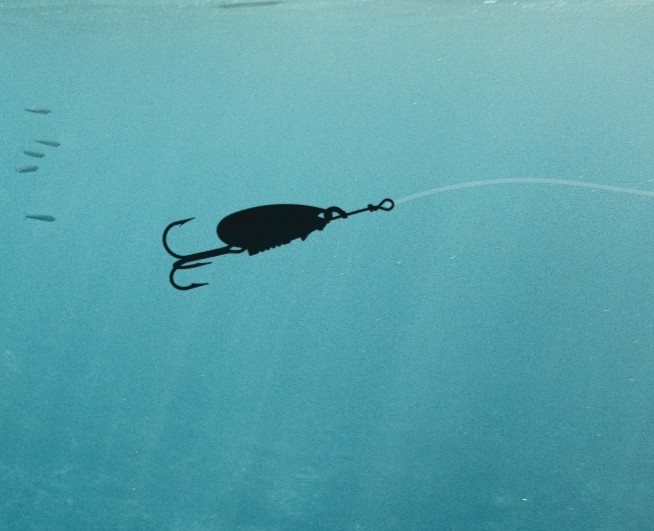
Salmon notice profile
Why baitfish shapes matter
Salmon don’t chase random things. They zero in on baitfish because baitfish are a high-energy food source. Herring, sand lance, anchovies—these shapes mean calories. Biologists studying salmon diets keep finding the same thing: when baitfish are available, salmon lean on them hard. So when salmon are on the hunt, they’re looking for something that generally looks like a baitfish — not a perfect replica.
If your bait doesn’t suggest “easy meal,” a salmon may investigate and move on.
Movement is part of the profile
Healthy baitfish swim straight and steady. Injured baitfish don’t — they roll, they flash. They spiral.
That wounded movement tells a predator the chase will be short. This is why rotation has always mattered in salmon fishing — rotation creates flash. Flash creates visibility. Visibility gives the fish a reason to commit.
Why skirt material changes the picture
Skirts aren’t just color. A fuller skirt creates a bigger baitfish silhouette and often slows the spin slightly. That reads like a bigger, wounded bait that can’t get away — more energy for less effort.
A thinner skirt spins faster and moves more. That can look like a smaller baitfish trying— and failing—to escape.
Both are baitfish cues. They just send different signals. When salmon follow but won’t bite, adjusting the profile and movement will often do more than swapping colors.
Scent still matters—maybe more than you think
Vision isn’t the only sense in play. Research on salmon consistently shows that they rely on smell to locate food. Scent travels much farther through the water than light does. Think of scent as the long-range signal.
Profile and movement draws them in and smell finish the job up close.
That’s why scent isn’t an add-on — it’s a core part of the system.
Putting it together, simply
If salmon are around but not committing, think through it like this:
• Does my bait look like a baitfish from a distance?
• Does the movement suggest an easy meal?
• Is scent working to bring fish into that decision zone?
When those line up, salmon are much more likely to finish.
The simple system we fish
This is exactly why Skirted Vortaks exist.
• The Vortaks head creates a wounded-baitfish spiral action.
• The skirt lets you fine-tune the baitfish profile and action.
• Used with scent, the system works on more than one sense at a time.
Gear designed and tested in Southeast Alaska — where tides run hard, and mistakes show up fast.
Skirted Vortaks — rotation + baitfish profile built for cold, tidal salmon water.
—
Scent Striker
Fill the Fish Box