
The Sound of Salmon Lures
Can fish hear? Finding tiny critters to munch in a vast ocean is not likely an easy task. But that's where using all of a salmon’s prey-location senses comes in. So, in this month's blog, we dig into the salmon's sense of hearing in finding food, or, for that matter, your salmon lure.

Hoochie bait rigged and ready to fish
The best salmon lures imitate the stuff they like to eat. The stuff kings and silvers like to eat most, in descending order of importance, are pisces, euphausiacea, and decapoda, according to the authors of Physiological Ecology Of Pacific Salmon, 1995. In non-scientific jargon, kings and silvers like to eat small fish (think herring and sand lance), krill, shrimp, and prawns. But, you knew that!
Hearing is the last element of the Scent Striker Bait Set-up Triangle but not necessarily the least important. If you remember our February blog, Salmon Lures Need Bait Triangle, you remember salmon don't talk to humans. So we have to figure out many things by studying fish behavior or just getting out there and wetting a line. That is what makes fishing so much fun!
WATER IS A GREAT SOUND TRANSMITTER
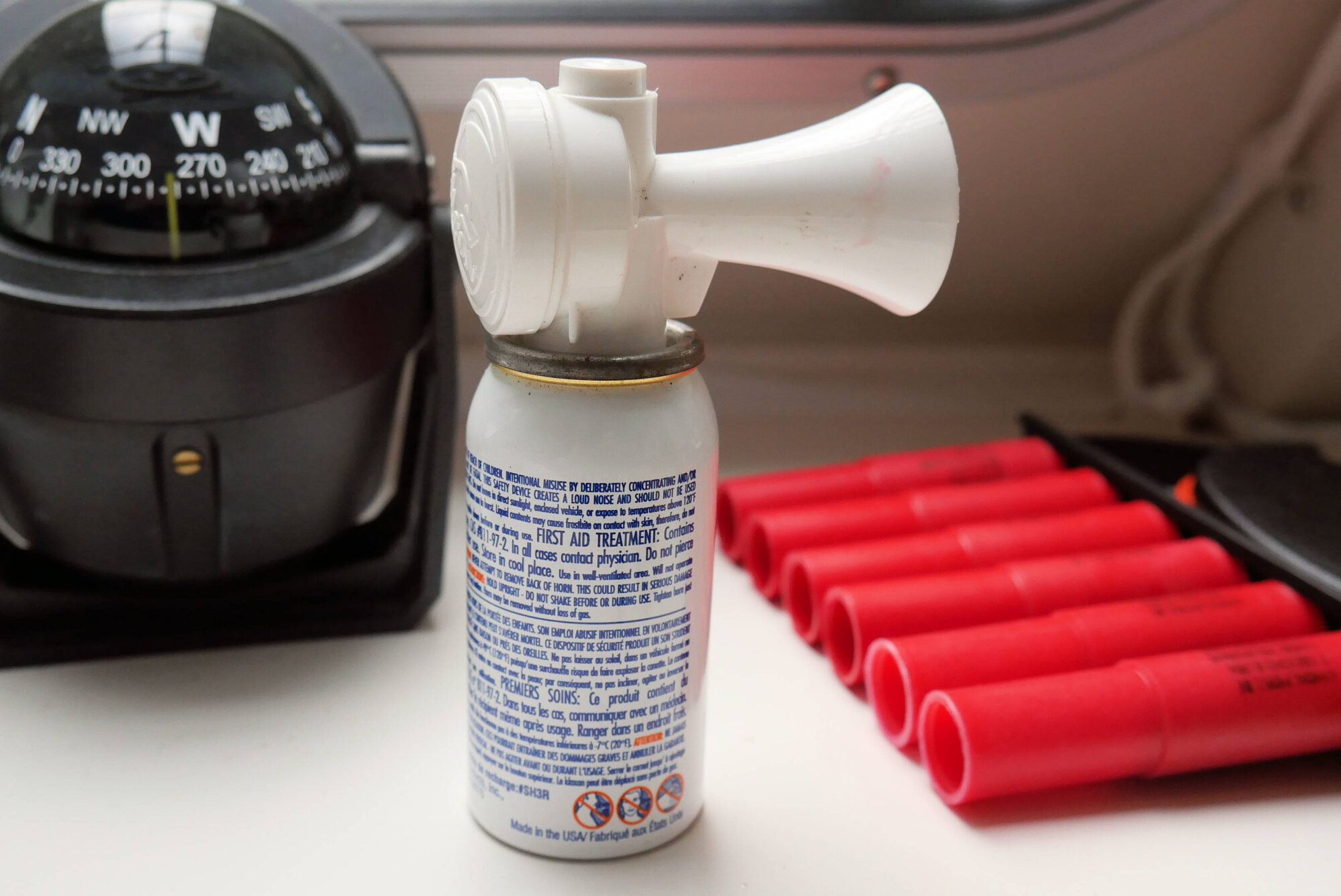
Boat air horn for small crafts
As you remember from school, sound is energy hitting our eardrums, traveling through nerves and ending in brain decodings, so that we recognize a boat horn or the singing of our fishing reel. Yet, when you hear your reel sing, your trophy fish has already swallowed your hook and taken off. So, you better grab that reel while you contemplate can fish hear!
For humans, sound must travel through the air, which transmits sound slower than the speed at which sound moves through the water. Due to its greater density, water transmits sound faster, and fish use this to their advantage.
Sound is particle and wave motion transmitted from a source into the surrounding water. Salmon hear these moving water particles and pressure waves. Like humans, salmon eardrums pick up pressure signals and send messaging through nerves to their brains for interpretation.
CAN FISH HEAR? SALMON HAVE 3-D SOUND AWARENESS
One of my favorite quotes on the ability of fish to pick out our lure through hearing is from the book, The Sense of Fish, Adaptations for the Reception of Natural Stimuli, edited by Von Der Emde, Mogdans, and Kappor, 2004. "Thus, the sleeper goby's ear as well as those in other fish is morphologically capable of being a 3-D sound detector." Therefore, we can begin to believe salmon not only know where your lure is, but they know its shape and speed through hearing its pressure signature. And through their sense of hearing, whether or not it's something they want to pursue and bite. Not only can fish hear, but they can hear well!
Interestingly, scientists have also identified the lateral line and the swim bladder as additional pressure-detection (hearing) systems. These systems work in unison so that salmon hear food sources near field (about a body's length away) and at distances. This sophisticated sound-detection system allows salmon to find food in a big ocean and positively confirms that fish can hear.
SUMMERTIME TESTING

As you might have guessed, the sound of salmon lures is serious business here at ScentStriker.com. Can fish hear is a question that has been on our minds. In fact, salmon hearing a fishing lure has become a significant consideration as we design and test new gear. This summer, we'll be conducting in-water testing on a new design intended to whisper to a nearby trophy king or silver, "come bite me." We hope our summer's testing proves our new design's ability to whisper to and catch fish. If successful, we are working toward launching it in 2023. Finally, don't forget about a salmon's keen sense of smell, and remember: TURBOCHARGE ALL YOUR BAIT SET-UPS THIS SUMMER WITH SCENT STRIKER!
Happy fishing! Don Habeger, Founder