

Halibut Rig How To: You’ll be ready for halibut fishing on the salt water soon with this science-backed halibut rig setup.
HALIBUT RIG: THE HALIBUT BITE WITH SCENT PLUMES
Halibut biting our bait with a great scent plume is a rig that begins with looking at some science. Not the dull classroom kind, but the kick in the pants hooking a barndoor-sized ‘but kind. Ok, maybe there’s a little classroom stuff, but only enough to understand why adding scent plumes to your halibut rig means fish in the box.
Here is the classroom science part: matter is neither created nor destroyed. Putting the fishing spin on that classroom fact boils down to this. Your fish attractant is made up of tiny particles. When your halibut gear hits the ocean bottom, tiny particles are dispersed in the water. Not destroyed and too small to see, these smell molecules follow the water current, creating a scent plume, which hits a hungry halibut’s nostrils down current. These scent molecules activate brain activity that tells halibut to swim over to your bait to investigate, taking a big bite.

HALIBUT HAVE EXCELLENT SNIFFERS
Researchers believe that halibut have a really keen sense of smell. One estimate is that halibut can smell one part per billion. That is one scent particle in a billion water particles. That is very keen—Better than a dog. Sending out a tremendous scent plume from your halibut rig means bite business.
How to do that? A simple solution is to use the Scent Striker Fob.

FOB’S SCENT SENDING POWER
To demonstrate the Fob’s scent-holding power, we do a simple experiment. A graduated cylinder is loaded with 81 milliliters of fish attractant.
A Fob is dipped into the fish attractant, stirred a bit to ensure lots of scent gets into its fibers, and pulled out of the scent pool to drip off excess fish attractant.
The end volume left in the graduated cylinder is about 62 ml. Subtracting the starting volume from the ending volume (81-62), we have 19 ml in the Fob. That’s a lot of scent to get out to halibut!

MAKING A HALIBUT RIG
Making your own halibut rig is not hard. If you like hands-on activities, making them can even be fun. Start with about 16- to 18 inches of heavy leader. I use a 150-pound clear monofilament line. Poke the line through one channel of a correct-sized double-barrel aluminum crimp sleeve.
Pulling the line out of the opposite sleeve end, guide the line from the eye’s back side towards the hook’s tip. Bend the line downward towards the hook’s bend and wrap the line around the back side of the hook shank. Pulling the line tip up toward the hook eye’s front (side of the hook eye facing the hook tip), poke the line through the eye so the line moves towards the aluminum crimp sleeve. To understand the process better, watch the how-to video.
Poke the line through the empty channel of the double barrel aluminum crimp until the line is flush with the channel’s end. Crimp the aluminum sleeve using a crimping tool. We use a CN-10-sized crimp tool in the video. A slightly undersized tool for the job, but it works.
Next, slide on a spacer bead above your hook crimp. A hard plastic spacer bead acts as a line protector to help prevent sharp halibut teeth from cutting through the line. You could run plastic spacer beads up your leader for four or five inches, but a quicker method is to cut a four-inch or so piece of plastic tubing and slide it on top of the spacer bead on your halibut rig.
Next, slide on several large plastic beads to your line, big enough to fill the head cavity of a nine-inch plastic squid about 5/8-inch in diameter). Then, string on your nine-inch squid and push it down so that the large plastic beads fill the head cavity.
Throw a second crimp sleeve onto the line about six inches above the squid’s nose to complete this halibut rig. Thread on a ball bearing swivel rated at 150 pounds or more onto the line above the crimp sleeve. Thread a small plastic thimble through the ring of the swivel. Wrap your line around the thimble’s groove, through the swivel ring, and back through the open channel of the second double-barrel crimp sleeve. Holding the crimp between two fingers, pull the line’s tag end until the thimble is tight against the top of your aluminum sleeve.
Crimp the second thimble with the crimping tool and cut any remaining tag-end line off near the sleeve’s end. Your rig is ready to fish.
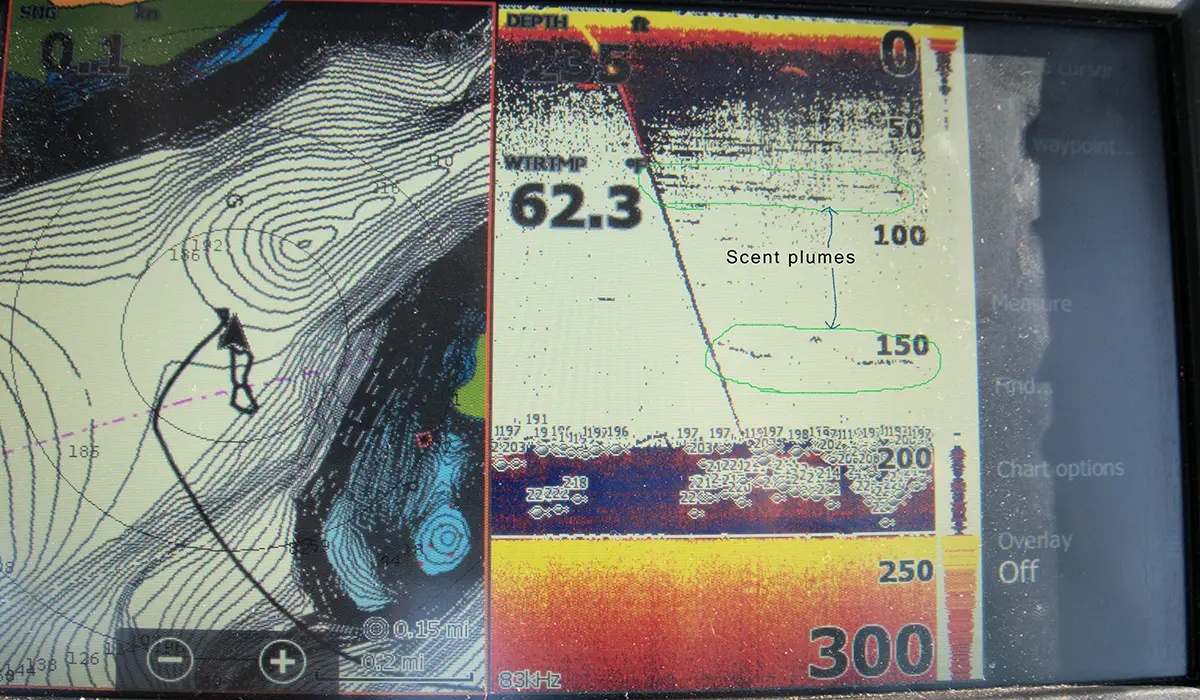
USING THE FOB TO CATCH HALIBUT
The picture above illustrates the Fob’s great halibut-catching scent plume. This picture was taken last season after we sent our halibut rig to the bottom. On happenstance, we walked into the cabin and saw that the sonar was picking up scent trails from our halibut rig. Amazed, we took a picture of the sonar screen.
Looking at the picture closely, you can see scent trails on the down-current side of the lure’s decent line but no returns bouncing off anything up-current of the decent line. Pretty cool!
Using the Scent Striker Fob to send out your halibut-attracting scent plume is as easy as one-two-three. Here are the steps: Load the Fob with your favorite scent sauce. Use the Fob’s duo lock snap to clip it on or near your squid rig. Third, drop it overboard and wait for the bite (don’t forget to jig to add movement to your squid skirt.)

HALIBUT RIG PUTS THEM IN THE BOAT
We caught a 60-pound halibut using a squid rig and the Scent Striker Fob. The fish was too big for our fish box and rode home on the back deck.
Happy Fishing!
Don Habeger
Founder