
Saltwater fishing tackle innovations occur when we better understand the motivations that cause fish to strike. The allure of Alaska fishing includes the wonder of probing the mysterious depths. And in doing so we get to discover salmon feeding habits. We spend time studying fishing reports and learn to tie the right baits. We watch tide tables and other fish-behavior data, but the moment a salmon swallows our hook is still a mystery. Above the water’s surface, our vantage point limits us to the reel’s song and the rod tip’s dance to tell the story.
Underwater Salmon Footage and Saltwater Fishing Tackle
Having stumbled on a bunch of underwater salmon footage, I discovered that the freely available footage opened a window to the subsurface world of salmon feeding attacks. And I plan to use this knowledge in the pursuit of developing evermore effective saltwater fishing tackle.
In our January blog I wrote about the connection to Coach Lombardi and football. Watching underwater footage is like studying game film. In doing so, we discover an opponent’s field habits. The more you watch, the more you find out your opponent’s field idiosyncrasies and potential weaknesses. We use this information to strategize offensive tactics for the advantage. It also helps when fine tuning our approach in choosing and developing saltwater fishing tackle.
Understanding Salmon Feeding Maneuvers
Likewise, the more we understand salmon feeding maneuvers on our baits through viewing underwater footage, the better we are in mounting our fishing offense. However, before revealing some findings, the first thing to acknowledge is the camera’s field of view limitations. The camera’s lens limits what we can see to a relatively narrow cone-sized perspective.
Nonetheless, we can glean salmon feeding attack preferences from studying this footage. For example, one fact is more salmon are lookers than biters. Seventy-one percent of the salmon entering the field of view did not end in a hookup.
We could debate the impact of a camera dragged in front of a bait setup on salmon bite behaviors and our resulting percentages. It’s still safe saying the number of salmon who bite is less than those that look a lure over. Careful bait rigging takes on more importance, given the odds, as does prudent decisions on what saltwater fishing tackle to use.
The Direction of Attack
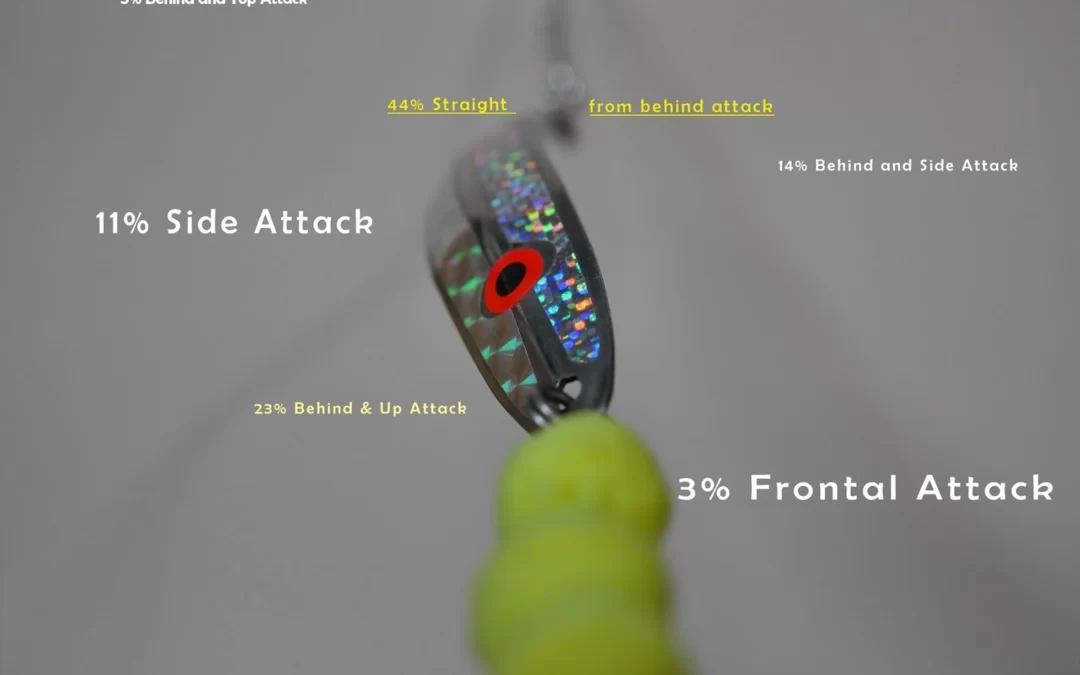
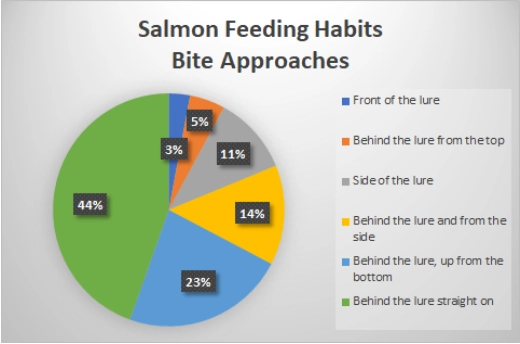 Another interesting observation is the direction of the attack. Eighty-six percent of salmon approach the lure from behind. Conversely, only fourteen percent of salmon attack from the lure’s side or its front. Almost half (45%) come in straight behind the lure in their attack. Another twenty-three percent come up from the bottom and the rear of the lure. These two attack approaches account for two-thirds of all prey assaults. It suggests a wolf-like running down predatory salmon feeding habit.
Now comes the dilemma of what to do with this newfound information. Unfortunately, I can’t say I know. However, if most attacks are from behind and from the depths, heightened elements of sight, smell, and sound contrast may be the best bait-setup strategy, and will be taken into account as I develop saltwater fishing tackle.
During this summer’s fishing season, I’ll experiment with these concepts. I’ll report back findings in future blogs. And, of course, all our setups will include Scent Striker and our new fish attractant product, DBS-Striker Formula. The prominence of rear attacks by salmon means a bread crumb scent trail is a critical offensive fishing technique. Stay tuned to learn about the saltwater fishing tackle developments that occur from our continued understanding of salmon feeding habits.