

Salmon lures come in many shapes and sizes, and some are more effective than others. In my quest to reveal what makes a lure effective, not one salmon, halibut, cod, or rockfish revealed the secret to biting our lures. Fish are a tough lot! None of them cracked under pressure when grilled with the question, “Fish, why did you bite my bait?” The Eureka moment did not materialize as hoped. Instead, all responded with blank stares.
However, all is not lost for fishing enthusiasts who want more fish to bite our salmon lures. Even though not one fish ratted out the school, we had another way to make them talk. That’s right, torture.
OK, maybe not torture like you’re thinking. We will not put salmon on the rack and stretch their pectoral fins. I’m talking about controlled, systematic, observational torture! The kind usually called science; the type that isolates a specific fish behavior in response to a particular stimulus, like a scent, color, or sound. You know, the cool kind of science that helps us catch more fish. This kind of torture acknowledges that sometimes you have to stick a very tiny measuring device inside a fish to make them spill the beans.
Fishing Secrets Through Science
For example, some researchers use probes to measure a cell’s electrical impulse. By doing so, researchers can tell which substances produce a charge that lights up a fish’s olfactory bulb. The olfactory bulb is a dedicated part of the fish’s brain dealing with smell. If we understand what lights up these brain cells in a way that triggers the feeding response, then we know what fish attractants to add to our salmon lures. That’s cool!
Another way to get fish to talk is to take them apart. The official term for this is dissecting. If, for example, you put the retina of a deepwater fish (think halibut) under an electron microscope and count the photoactive cells, you likely count more rods. However, if you put the retina of a fish that lives near the surface (think salmon) under the electron microscope, more cones cells than rod cells are present. 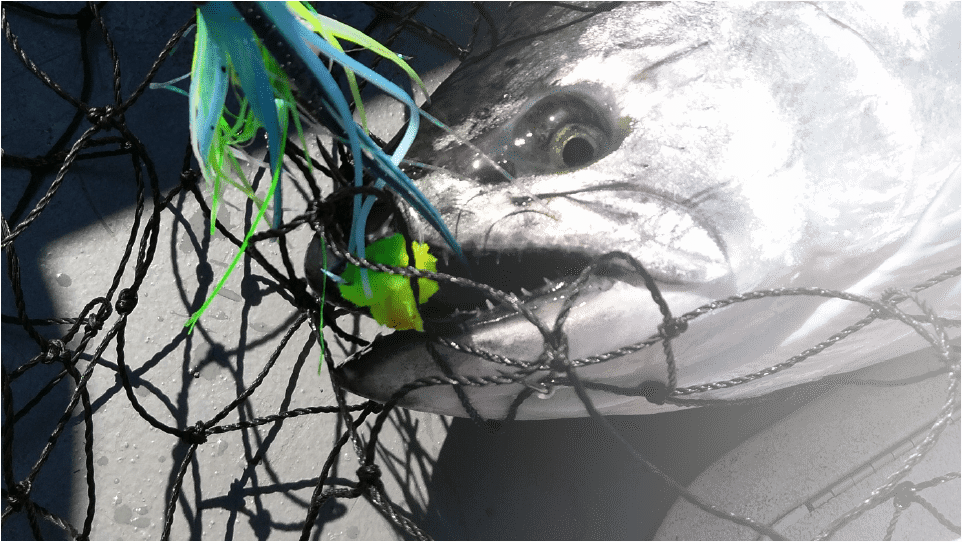
Why does this matter to fishing enthusiasts?
Knowing the fish’s photoreceptor types can inform our salmon or halibut lure choices. For example, when fishing in the early morning for that big king, you might choose white. A white lure will bounce more light to the predominant color-detecting cone cells in diminished light conditions. But, in the middle of the day, you might use a brightly colored lure with green, blue, or chartreuse for added color pizazz to catch cone cells’ attention.
Are you bottomfishing for slabs? Contrast is an excellent friend when after bottom dwellers, as their light comes from above them. A dark jig or grub would highly contrast lighter surroundings to halibut eyeballs full of rod cells and looking up, especially if the sun is out.
One team of clever researchers used thread to get fish to talk. By putting the thread in the lateral line on one side of the fish, they discovered that they had difficulty determining distance to the prey source on the one side but not the other. What? Fish use “sound” to determine where their next meal might be? The researchers say they do!
Many of us have experienced special salmon lures, say a spoon or spinner, that outperforms others even though they look the same to our eyes. It may be that when fished, these hot lures produce a slightly different pressure wave (sound) that better excites the fish’s lateral-line sensors. We all try to get the wounded-herring roll in our baits when salmon trolling, don’t we? That is leveraging “sound” to fill our fish boxes.
Salmon Lures and The Bait Set-up Triangle

By now, you’ve probably guessed we are laying out the three elements of Scent Striker’s Bait Set-up Triangle – Sight, Smell, and Sound. In getting ready for the 2022 fishing season, we should consider how our new salmon or halibut lure purchases address the three senses.
Our January blog talked about Coach Lombardi going back to football fundamentals with his team, “Gentlemen, this is a football.” But, in fishing, it all boils down to triggering the bite and hooking up. And, to get the bite, we need Sight, Smell, and Sound. At Scent Striker, we think these three elements are fishing’s fundamentals. So, to adapt a famous football coach’s saying to our sport, “Gentlemen (ladies too) this is a lure, it needs Sight, Smell, and Sound.”
Let’s gear up with the Bait Set-up Triangle in mind. And, don’t forget Scent Striker and our new fish attractant DBS-Striker Formula. Being cognizant of how sight, smell and sound factors effect our salmon lures is the first start to getting fish to talk.
Bring on the 2022 season!
Don Habeger is an avid angler and the Founder of Scent Striker.