

Alaska Salmon Attractants
It was a lovely day on the water. I came home happy and tired. Fishing was good.
As I walk through the front door, an aroma hit me full in the face. I immediately know my wife made one of my favorites, strawberry-rhubarb pie — what a smell. I suddenly realize how hungry I am.
The sense of smell is vital to humans. We love certain odors, others we have learned to avoid. It is the same with fish.
A fish’s keen sense of smell
Certain fish, catfish, for example, have an exceptional sense of smell. In some of the scientific literature, I’ve seen various species of catfish referred to as “swimming tongues.” They have this moniker because taste buds cover their entire body. Catfish have been observed to react to fish attractant concentrations in very tiny amounts.
I’m not a catfish fisherman, not yet at least. I am an Alaska fisherman; catfish don’t live in my area, but salmon do. While not “swimming tongues,” salmon have a keen sense of smell. Decades of research show salmon respond positively to food-based odors, which means that certain smells trigger a fish’s feeding response. A salmon’s response to the presence of these odors has been observed to include increased searching and seeking activity. In other words, they start looking for food, or for the fishing enthusiast, your bait.
It is wise to remember salmon respond to their environmental smells, not ours. Odor avoidance by fish is something to keep in mind. I once read a research piece that described the response of fish to a “finger rinse.” The researcher swished their finger in a beaker of distilled water and introduced the solution to fish. Sure enough, the fish demonstrated an avoidance reaction when in the presence of the solution.
Using fish attractant in your bait
The question remains, then, what should you do to trigger a feed-seeking response in fish? One solution is to add fish attracting oils, gels, sauces to your bait setup. Fish attractants are readily available and come in all types of ‘flavors,’ such as herring, shrimp, anchovy, etc. Borrowing an adage from the trout fishing enthusiasts, choose a ‘flavor’ that “matches the hatch.” In other words, if you are targeting salmon, select a herring scent since this is an essential food source for them.
Another component to triggering a feed-seeking response is holding your fish attracting oil, gel, or sauce in a sufficient quantity to initiate a scent trail, and putting the scent in a location that is advantageous to a hook-up. Scent Striker® was developed to do just that. You can string one or more anywhere on your leader due to the hollow Scent Striker® center. Add lots of fish attracting oil, gel, or sauce by dipping the Scent Striker® into a small pool of your favorite fish odor-producing product, and getting your gear quickly into the water where the odorant is dispersed.
Scent Striker® is effective
 On one of my recent outings in SE Alaska, targeting Silver salmon, a few Scent Strikers® tied in with an artificial blue cut plug herring rig and dipped into a shrimp based fish attractant was quite effective. On this particular day, I hooked into three Silvers. I’ve added a picture of one of the caught Silvers with the Scent Striker® bait set-up so that you get a better idea of how to use Scent Striker®.
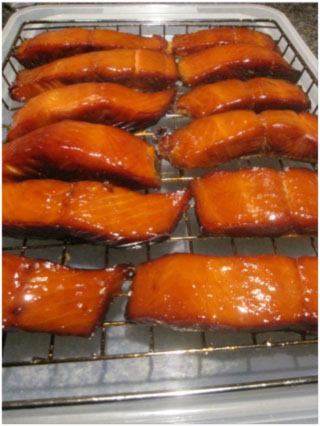
A few days later, I had racks of Silver salmon in the smoker. The alder wood smoke wafting out lazily in the evening air. The aroma was pleasing, and the thought of freshly smoked salmon made my mouth water. Scent Striker® helped make this possible. Is it time for you to add Scent Striker® to your fish-catching arsenal?